

Advanced security screening products in Nigeria are the detection systems that protect airports, borders, government buildings and critical infrastructure from weapons, explosives and contraband. This guide explains what these systems are, how each core technology works, and where they are deployed across high-risk Nigerian environments.
We wrote this for procurement teams, facility managers, and security planners who need accurate information before they buy. Logic Sciences Security Systems Limited, based in Surulere, Lagos, is the only registered distributor and technical service partner of Rapiscan Systems in Nigeria, and the first certified partner of Morse Watchmans.
Advanced Security Screening Products in Nigeria: What Are Advanced Security Screening Products?
Security screening products are devices that scan people, bags, cargo and vehicles for prohibited items such as weapons, explosives and narcotics. The “advanced” tier goes further than walk-through metal detectors and basic X-ray. These systems use 3D imaging, automated threat algorithms, biometrics and trace chemistry to find concealed threats that older equipment misses. They are designed to detect both metallic and non-metallic items while keeping passenger and visitor flow moving.
The shift matters because threats have changed. Traditional 2D X-ray, broadly unchanged in operating principle since the 1970s, struggles with concealed explosives and dense clutter, which is why regulators have pushed toward computed tomography and automated detection at checkpoints. The result is faster, more accurate, less intrusive screening.
Types of Advanced Security Screening Products in Nigeria and How They Work
The systems below form the core of modern screening. Each solves a specific detection problem, and most high-security sites combine several into one layered checkpoint.
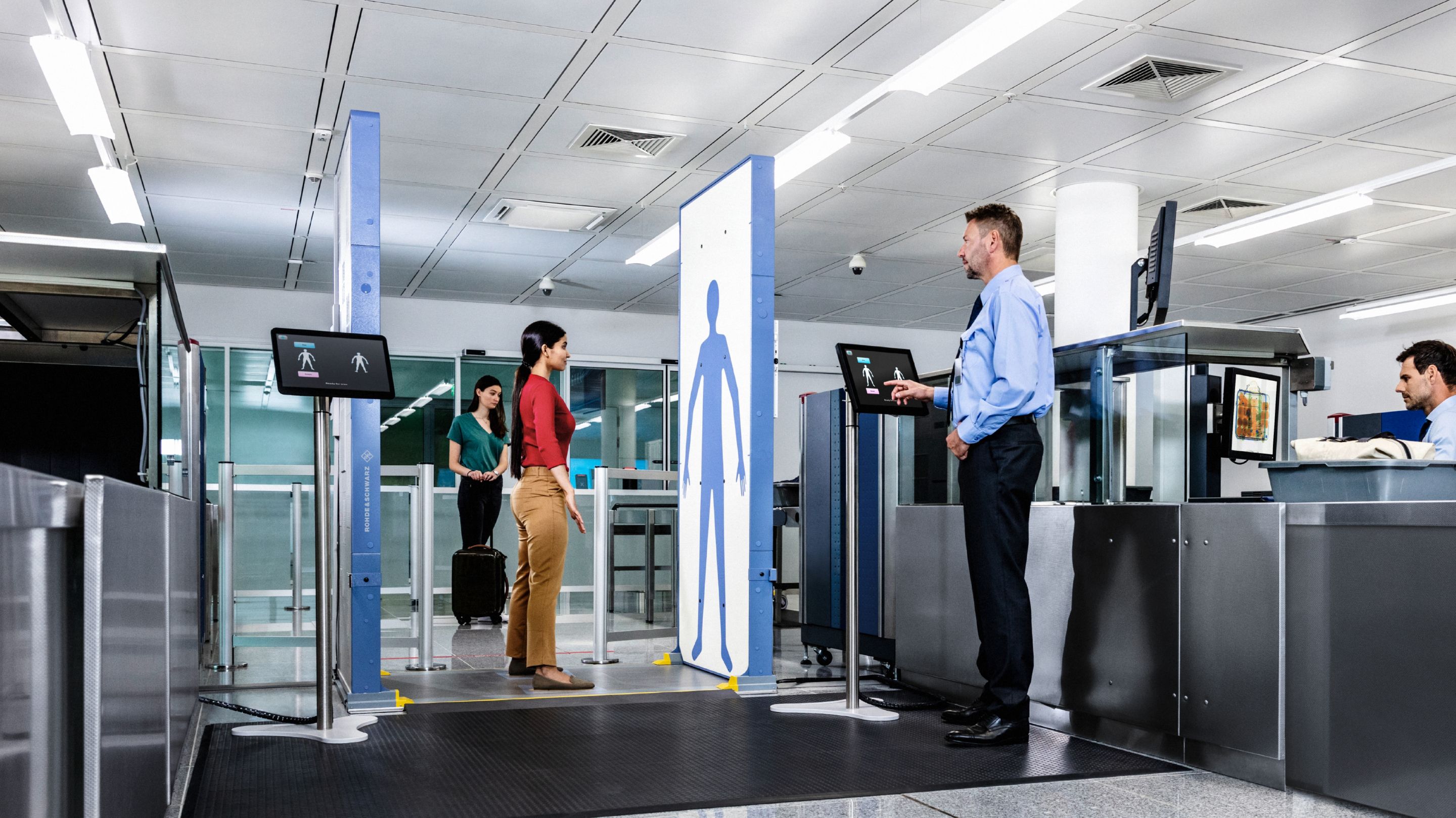
Advanced Imaging Technology (Body Scanners)
Advanced Imaging Technology (AIT), commonly called a body scanner, screens a person for concealed items without physical contact. In modern airport deployments, AIT commonly uses millimeter-wave technology, which emits low-power, non-ionizing radio-frequency waves. Millimeter waves fall within the 30 to 300 gigahertz range.
Also read: Where Do I Get the Best Security Products and Services in Nigeria
During screening, the waves reflect from the body and from objects concealed under clothing. The scanner’s antenna array receives the reflected signals, and onboard software processes them to identify anomalies. Modern systems use Automated Target Recognition (ATR) software, which protects privacy by showing potential threat areas on a generic body outline rather than displaying a passenger-specific body image.
AIT is useful because it can detect both metallic and non-metallic items concealed under clothing, including objects made from materials such as plastic, ceramic, powder, liquid, gel, and metal. This allows it to detect some threats that a walk-through metal detector may miss.
Computed Tomography (CT) X-Ray for Baggage
Computed tomography brings medical-grade 3D imaging to baggage screening. A CT scanner takes hundreds of X-ray images as the camera rotates around the conveyor belt, then builds a 3D model an operator can rotate 360 degrees on screen. Detection algorithms automatically flag explosives, including liquid explosives, inside the bag. Because the image quality is so high, passengers can often leave laptops and travel-size liquids inside the bag, which speeds up the queue. The Rapiscan 920CT supplied in Nigeria is approved to the ECAC C3 and TSA APSS standards for cabin-baggage screening.
Explosives and Narcotics Trace Detection (ETD)
Trace detectors find microscopic residue left on hands, clothing, luggage or cargo after someone handles explosives or drugs. An operator wipes the surface with a swab, then inserts it into the unit, which heats the sample to vaporize it. Most systems use ion mobility spectrometry (IMS): the vapor is ionized and the charged molecules travel through an electric field in a tube, where each compound is identified by its distinct travel time. A match against a known-substance database triggers an immediate alert. The same swab-and-analyse method screens for narcotics, which makes ETD vital in prisons as well as airports.
Baggage and Parcel Inspection Systems
Dual-energy X-ray systems scan baggage, parcels, and cargo using two X-ray energy levels to help distinguish between different material types. Operators view colour-coded images that differentiate organic, metallic, and mixed materials, helping them identify potential threats or contraband for further inspection.
Airport hold-baggage operations, courier sorting centres, and cargo screening facilities use High-throughput tunnel scanners. Rapiscan Systems supplies a range of baggage, parcel, and cargo inspection systems with different tunnel sizes and capabilities. The goal is fast, non-intrusive screening that maintains security while keeping passengers, parcels, and freight moving efficiently.
People Screening and Biometric Systems
People screening covers walk-through detection plus biometric identity checks such as facial recognition and fingerprint scanning. Biometrics verify who a person is and can speed up access by reducing reliance on physical documents. Combined with AIT, they let high-security sites confirm both identity and the absence of concealed threats at the same checkpoint.
Walk-Through Metal Detectors and Trace-Enabled Portals
Walk-through metal detectors remain the first-line tool for finding metallic weapons on a person. In advanced deployments they sit alongside AIT and ETD so that metallic and non-metallic threats are both covered, rather than relying on metal detection alone.
Vehicle, Cargo and Specialist Scanners
Larger systems extend screening to vehicles and freight. Mobile and fixed cargo X-ray systems inspect trucks and containers at borders and ports; under-vehicle scanners image a vehicle’s undercarriage for hidden threats; and liquid explosive detection systems check bottles and containers. These tools let officers inspect high volumes without unloading every shipment.
Advanced Security Screening Products in Nigeria: Where Are Advanced Security Screening Products Used?
These systems matter most where people, goods or vehicles move in volume and the consequence of a missed threat is severe. The table summarises the main environments and the technologies each typically relies on.
| Environment | Typical screening technologies |
|---|---|
| Airports and aviation hubs | CT X-ray for baggage, millimeter-wave body scanners, ETD, liquid explosive detection |
| Borders and customs | Mobile and fixed cargo X-ray, vehicle inspection systems, trace detection |
| Government buildings and embassies | People screening, biometric authentication, X-ray and walk-through detection |
| Critical infrastructure | Personnel, vehicle and delivery screening at power, water and telecom sites |
| Mass transit | Walk-through detectors and trace analysis for bags and passengers |
| Correctional facilities | Full-body scanners and narcotics trace detection for inmates and visitors |
| Logistics and parcel hubs | Parcel and freight X-ray for contraband and hazardous goods |
Aviation is the most recognised use case. Globally, airports are adopting CT at the checkpoint precisely because it raises detection accuracy while reducing manual bag checks. In Nigeria, the same logic applies across the country’s international airports, seaports and federal facilities, where high traffic meets elevated threat levels from smuggling and terrorism.
Advanced Security Screening Products in Nigeria: Why Advanced Screening Matters in Nigeria
Nigeria faces overlapping risks: smuggling, narcotics trafficking, terrorism and unauthorised access to sensitive sites. Advanced screening addresses these by detecting threats early and non-intrusively, which protects people without grinding operations to a halt. The technologies also democratise expertise: tests that once required a lab and a skilled technician now run in minutes through a guided device, so trained operators rather than scientists can clear a checkpoint.
Investment is therefore not a luxury but a baseline requirement for any high-traffic, high-value facility. The practical question for Nigerian buyers is not whether to screen, but which combination of systems fits their specific threat profile and throughput.
Where to Buy Advanced Security Screening Products in Nigeria
Commercial-grade screening equipment must be sourced through an authorised distributor that also provides configuration, installation, training and long-term technical support. In Nigeria, Logic Sciences Security Systems Limited fills that role. It is the only registered distributor and technical service partner of Rapiscan Systems, a global leader in X-ray and screening technology, and the first certified partner of Morse Watchmans for key and asset management. Its supported product range includes:
- Explosives and narcotics trace detection (ETD)
- Computed tomography and baggage and parcel inspection X-ray systems
- Walk-through people screening and biometric systems
- Intelligent key and fleet management systems
- Smart-locker storage and guard-patrol solutions
The buying test is straightforward: confirm manufacturer authorisation, in-country technical support and after-sales maintenance. Equipment that must stay compliant and operational for years needs a partner who can service it locally, not just sell it.
Advanced Security Screening Products in Nigeria: How to Choose the Right Screening System
Use these criteria when specifying advanced screening for a Nigerian facility:
- Match technology to threat: CT and ETD for explosives, AIT for concealed body threats, cargo X-ray for freight.
- Check certification: For aviation, prefer systems approved to recognised standards such as ECAC and TSA.
- Plan for throughput: Match tunnel size and scan speed to passenger or parcel volume.
- Verify authorised supply: Buy from a registered distributor with local service capacity.
- Budget for the lifecycle: Include installation, operator training, consumables and maintenance, not just the unit price.
Advanced Security Screening Products in Nigeria: Frequently Asked Questions
What counts as an advanced security screening product?
It is screening equipment that goes beyond basic metal detectors and 2D X-ray. Examples include millimeter-wave body scanners, computed tomography baggage scanners, explosives and narcotics trace detectors, and biometric people-screening systems. They use 3D imaging, automated detection algorithms and trace chemistry to find concealed metallic and non-metallic threats.
How does an airport body scanner work?
Most airport body scanners use millimeter-wave technology, emitting non-ionizing radio waves that reflect off the skin and any concealed object to build a scan. Automated target recognition software then shows any threat as a box on a generic outline that is the same for everyone, so no personal image is displayed.
Why can I leave liquids and laptops in the bag with CT scanners?
Computed tomography produces a detailed 3D image that the system can analyse automatically for explosives, including liquids. Because the image is so clear, officers no longer need passengers to remove electronics or travel-size liquids in most cases, which reduces bag checks and speeds the line.
How do explosives and narcotics trace detectors find threats?
An operator swabs a surface, then the unit heats and ionizes the sample. Using ion mobility spectrometry, it measures how long the ionized molecules take to cross an electric field and matches that signature against a database of known explosives or narcotics, alerting the operator within seconds.
Where can I buy these systems in Nigeria?
Source them from an authorised distributor with local technical support. Logic Sciences is the only registered distributor and technical service partner of Rapiscan Systems in Nigeria and the first certified partner of Morse Watchmans, supplying screening, trace detection and key-control systems with installation, training and maintenance.
Are body scanners safe?
Millimeter-wave body scanners, the type used in most airports, use non-ionizing radio waves rather than ionizing X-rays, and meet recognised national and international health and safety standards.
Advanced Security Screening Products in Nigeria: Conclusion
Advanced security screening products in Nigeria are now essential infrastructure for airports, borders, government sites and critical facilities. The strongest checkpoints layer several technologies: CT and ETD for explosives, body scanners for concealed items, cargo X-ray for freight, and biometrics for identity. Matching the right mix to your threat profile, and sourcing it from an authorised, locally supported distributor, is what turns equipment into reliable protection.
To specify, buy or service advanced screening systems, contact Logic Sciences Security Systems Limited for a needs assessment and quote. Call +234 703 437 0748, email info@logicsecurity.ng, or visit logicsecurity.ng to find the right solution for your facility.
Stay connected to our blog for more useful day-to-day updates. You can also follow us on X (formerly Twitter) @Logic_sss for more.

